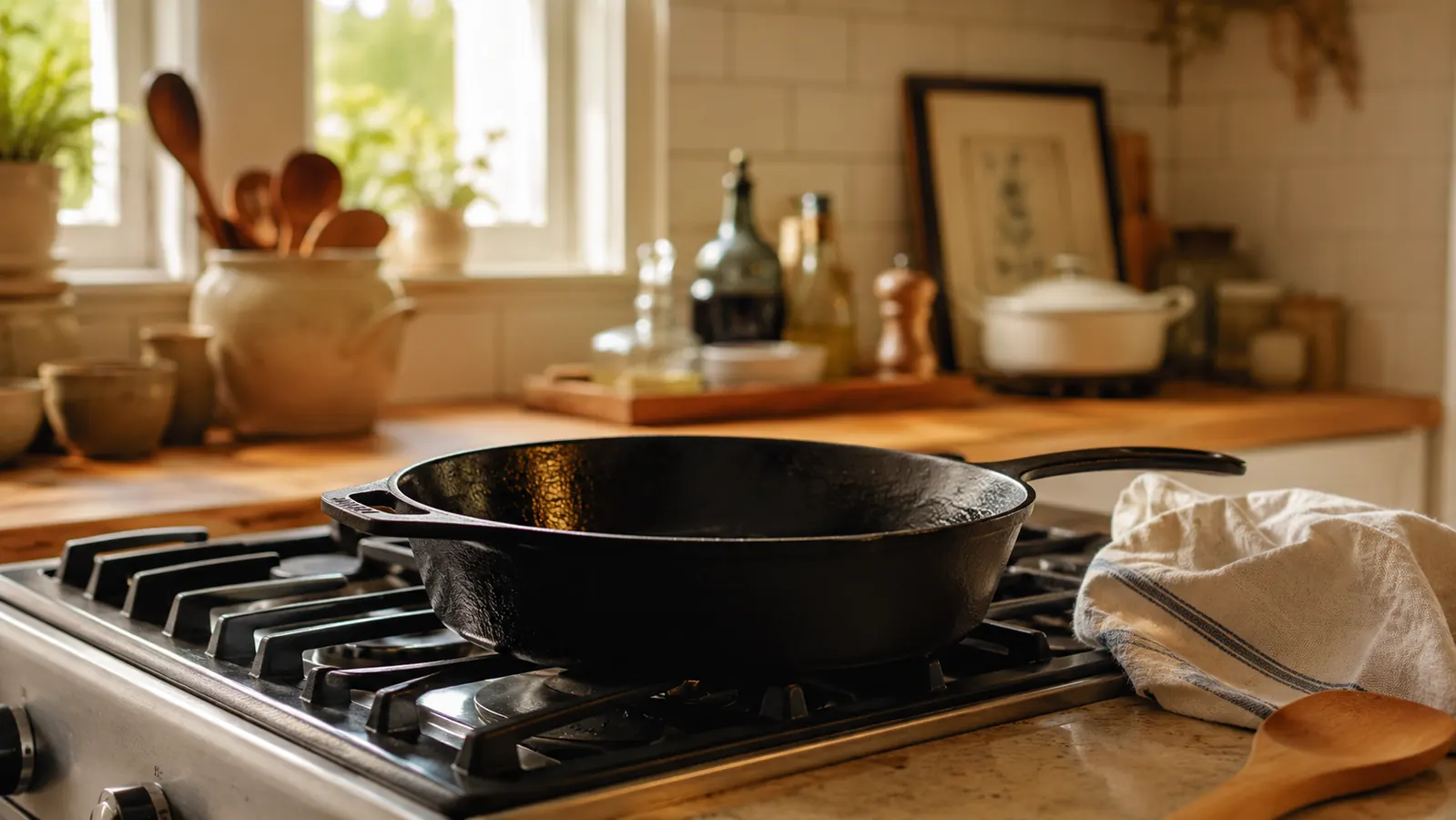
This is the review nobody asks for. Before you buy a Lodge cast iron skillet, nobody sits you down and tells you it is heavy, that it wants more attention than the Teflon pan you probably grew up on, and that the glossy black seasoning in the catalogue photos is mostly future work, not present glory.
I have cooked with my 10.25-inch Lodge for three years now, at least four nights a week. I am a home cook in my late fifties, I have two dogs underfoot who treat the kitchen floor like a racetrack, and I do not buy kitchen things to admire them. I buy them to feed people. So this is the plain truth about what the Lodge does, what it will not do, and the parts the marketing leaves out. If you read this and still buy one, you will buy it with your eyes open and your expectations honest.
The Quick Verdict
The best workhorse I own for the money, as long as you accept the weight and the two-minute wash every time. It is not a set-and-forget pan, and the people who say otherwise are selling something.
Amazon Check Today's Price →Need the honest workhorse that will outlive your other pans?
This is the exact 10.25-inch Lodge I have cooked on for three years. Plain, pre-seasoned, built to be passed down. Check today's price on Amazon.
Amazon Check Today's Price on Amazon →How I've Used It
My Lodge lives on the stove, on the left rear burner, because it is too heavy to be lugged in and out of a cupboard every day. If that sounds lazy, I would argue it is honest. At somewhere near four and a half pounds empty, this pan is a workout on its own, and the smart move is to treat it as a resident of the stovetop rather than a guest you fetch for special occasions.
An average week here looks like this. Sunday, cornbread in it, because nothing else on earth makes a crust like cast iron. Monday, a fried egg or two with the dogs doing their little dance behind me at the edge of the counter. Midweek, hash browns, which used to be a sticky tragedy in my nonstick and are now a weeknight staple I actually look forward to. Most weekends, at least one seared steak, because the pan holds heat the way an oven floor does, and it turns out a crust no other pan in my drawer can match.
I keep a couple of pieces of paper towel and a bottle of cooking oil within arm's reach of the stove, the same way some people keep a sharpener beside their knife block. That little setup is what makes the honest washing routine possible, and I will get to that in a minute, because it is the part everyone dances around and the part that decides whether you keep this pan or quietly re-home it.

What Nobody Tells You About the Weight
Here is the number nobody says out loud. The 10.25-inch Lodge weighs roughly four and a half pounds empty, and closer to six once you add food and the pan is hot. For me, in my fifties with the start of an arthritic thumb, that is a real consideration, not a nitpick. I can manage it fine with both hands, and I almost never lift it with one.
Tell yourself the truth now, before you order. Do you lift a full pan with one hand while you toss or pour? My answer was always yes to that with my old nonstick, and it is a firm no with this one, and I have adjusted my cooking around it. Pouring grease off a loaded pan is a two-handed, careful job with the Lodge. That is not a flaw in the pan, it is a fact of what thick cast iron is, and you should account for it before the box arrives, not after you have a burning six-pound skillet in one hand and a serving spoon in the other.
The Seasoning Myth
Ask a seasoned cast iron owner and they will tell you their pan is nonstick, hand it to you across the kitchen, and watch you try eggs on a pan that is at a totally different stage of its life than yours will be on day one. That is the real gap nobody explains. Their pan has been cooked on, washed, and oiled hundreds of times. Yours has been fired in a factory once. The two are different pieces of equipment, and comparing your first morning to their fifth year is like judging a new cast iron pan by somebody's twenty-year-old marriage.
Here is the part that makes people roll their eyes, and rightly. You will read that a Lodge comes pre-seasoned and is nonstick out of the box. That is true the way a puppy being house-trained is true, which is to say, it is a start, not a finish. The factory seasoning on a new Lodge is a serviceable first layer, and it will get better the more you cook with fat in it, but it is not the slippery silver finish you see in photographs, and anyone who says breakfast eggs slide off a brand-new one is describing a different company's product or a trick of the camera.
The honest news is that the seasoning does not need ritual or mystery to develop. It needs you to cook. Every time you fry an egg in butter or sear a steak in a thin slick of oil, you are laying down another microscopic layer of polymerized oil, and that is the whole of it. The pan literally gets better with age, which is the one genuinely good thing about old cast iron and the reason people keep them for decades. In three years mine has gone from serviceable to genuinely nonstick for eggs, with zero effort beyond ordinary cooking and the wash routine below.
And here is the honest counterweight. Because the seasoning is not a bonded coating the way a factory nonstick is, it is a layer you can damage. Acidic things cooked for a long time can strip it. Leaving a tomato sauce bubbling in a red-hot pan is not the pan's strong suit. I keep my tomato-based cooking to my stainless pot and save the iron for the food it wins at. That is not a compromise I am bitter about, it is just knowing what the tool is for, and it saves me the heartache of watching my hard-won seasoning wash away down the sink.
What It's Actually Brilliant At
Three things, and these are the reasons the Lodge survives in my kitchen when three nonstick pans have gone to the recycling bin in the same stretch of years. The first is the sear. Cast iron holds heat the way a stone holds the warmth of the sun, so the moment a steak hits the surface the pan does not dip in temperature and simmer the meat, it keeps a hard, even sear going the whole cook. My steaks got visibly better the week I switched, and they stay better.
The second is the heat-shock forgiveness. A nonstick pan warps or flakes if you crank it on high and then hit it with a splash of cold something. Cast iron shrugs at high heat all day. When a recipe says get the pan screaming hot first, this is the pan that means it, without you worrying you have just ruined the coating and without that faint overhang in the back of your mind every time you use a delicate pan.
The third is the economics, and I will be blunt. This skillet sits in the same price range as a throwaway nonstick, yet it is the same pan today as it was on day one, only better. My beloved stainless pot cost a small fortune by comparison. My last two nonstick pans each cost more than this one and each was in the trash inside two years. You are not buying a disposable layer glued onto a pan, you are buying a solid hunk of metal that will still be here when we are all gone. I have stopped counting the money this one pan has saved me, but I remember that my first month with it already felt like a bargain.
Three years, four nights a week, one skillet. The only thing I have had to let go of is my old habit of scrubbing it to a shine, which was wrong, and which was the whole problem.
The Two-Minute Wash Routine
Every person who dismisses cast iron as too much upkeep is describing a routine they were never taught. Here is the whole thing, and it takes two minutes, which is less than the setup on most new digital appliances eating my counter space.
While the pan is still warm but not hot, I run it under hot water with no soap, which for most meals is plenty. On the stubborn bits, I use a stiff brush or a chainmail scrubber, and I find the chainmail is worth its tiny cost, because it knocks off burned-on food without scratching the seasoning the way a steel scouring pad does. Then I dry it on a low burner for about a minute, wipe the thinnest film of oil over the whole cooking surface, and it goes back on the burner rack ready for tomorrow.
That minute of drying on the burner matters. If you let cast iron sit wet, or worse, soak in a sink, you are inviting rust, and rust is the one thing that will actually hurt a pan. So no soaking, ever, and no dishwasher, ever. The rule of thumb I live by is simple. Never leave it wet, never leave it empty on a hot burner for long, and oil it after the wash. That is the entire of it, and it is a set of habits, not a skill test. Within two weeks the routine stops feeling like a chore and starts feeling like the small ceremony of putting your workhorse to bed.

The First Week: What to Expect
I would rather tell you straight what the first week looks like than leave you to wonder and panic. The pan will not be slick. Your first egg might stick more than you hoped. You might, as I did, search the internet at ten at night convinced you have ruined a brand-new pan because a ring of gray showed up after you cooked a tomato dish. You have not. It is seasoning in motion, and it is normal.
Start with the forgiving foods for the first seven days. Fry potatoes, sear chicken, bake cornbread. Skip the delicate eggs and the long acidic sauces until the pan has a few good layers under it. Do the two-minute wash every single time without skipping, and by the second week you will feel the surface begin to turn glossy and food will start releasing the way you hoped it would on day one. Patience here is not hype, it is just how a seasoning grows, and it is the difference between people who love their Lodge and people who gave up on it.
What I Reach For It For
If you are reading this to decide whether to make the switch, here is the honest list of what this pan wins, and it is a long list. Cornbread, dutch potatoes, hash browns, seared steak, fried eggs, roast chicken, pizza on the stove where you finish the top under the broiler, and the single best grilled cheese sandwich of your life. Anything that wants a hard browned crust and steady heat, the Lodge is the answer.
And here is the honest list of what I do not use it for, so you have the whole picture and not the half one. I do not simmer a long Italian rag in it, because acid and long heat are the seasoning's enemy. I do not keep it for delicate fish, because I have a thin nonstick-for-life pan for that and it is not the one that wears out. And I do not give it to guests to wash mid-party, because the good Samaritan who scours and soaks is the fastest way to set my seasoning back. I wash it myself, and that is that.
What I Liked
- Sear and heat retention that beat any nonstick I have owned
- Costs a fraction of a good stainless or nonstick and outlives them all
- Gets better with every use, not worse
- No chemical coating to flake, scratch, or wear off into your food
- Nearly impossible to break, meant to be passed on a generation
- Won a weeknight fried egg and hash brown permanently and cheaply
Where It Falls Short
- Heavy, roughly four and a half pounds empty and more when full
- Needs the two-minute wash and dry-and-oil routine every time
- Long acidic cooks can strip the seasoning
- No dishwasher, ever, and no soaking
- Newer pan is not truly nonstick until seasoning builds with use
Who This Is For
This is for the cook who wants one pan that does the heavy work for years and is tired of throwing out nonstick after every second strict spring clean. It is for the person who does not mind two minutes of hand washing after dinner, who actually enjoys that a tool rewards use, and who would rather own four excellent things than forty mediocre ones. If you cook most days and you value a crust and a sear, the Lodge will make you dinner tonight and still be making you dinner the year you retire.
Who Should Skip It
Be fair to yourself, because the honest review cuts both ways. If you have real trouble lifting a heavy pan with any fullness in it, or if your hand and wrist would protest, this is the wrong tool and there is no shame in a good lightweight pan. If you hate hand washing, or you simply will not remember to dry and oil it after use, you will end up fighting rust and you will blame the pan when it was never the pan's fault. And if you mostly make gentle, long-simmered acidic meals, a stainless pot serves you better. The Lodge is a workhorse, not a universal answer, and the honest version of lavishing praise on it is to also tell you who should walk away and have a clear conscience doing it.
Ready to stop buying pans every two years?
If you accept the weight and the two-minute wash, this Lodge will be the last skillet you buy for a long, long time. It is honestly that good for the money.
Amazon Check Today's Price on Amazon →