

I'll be honest with you. I almost did not write this one. The KitchenAid stand mixer is the most reviewed small appliance in my kitchen, and a fair share of what gets written about it reads like the brand's brochure. I have had mine for fourteen months now, used it on most days, and there are things about it that genuinely get on my nerves. I want you to know those before you think about spending the money.
So here are my ground rules up front. I cook most nights, I bake bread twice a week once the weather turns cool, and I keep a golden retriever who patrols the kitchen floor waiting for anything that drops. I am not a gadget chaser. My rule for any small appliance is simple: it has to earn its counter space, it has to be easy to clean, and it has to be something I am still reaching for in twenty years. The KitchenAid has been in my kitchen long enough now to give you the real answer, the good parts and the grinding parts.
The Quick Verdict
Still the best all-around stand mixer I have ever used, but it needs honest limits around bowl size, hand washing, and not overpaying for the attachments you will never pull out.
Amazon Check Today's Price →The Short Version of My Verdict
If you bake bread or cookie dough more than once every couple of weeks, buy it. If you are a once-a-month baker who mostly beats eggs, this is a lot of money, and a hand mixer honestly does the job. There is no shame in either answer.
Amazon Check Today's Price on Amazon →How I've Used It
My routine is boring, and I think that is exactly the honesty this review needs. Most weeks I make one or two loaves of bread, a batch of cookies when the mood hits, whipped cream for a Friday dessert, and mashed potatoes side on a Sunday. That is it. No frosting competitions, no pasta rollers, no macaron marathons. If this machine can handle the plain, humdrum baking that real kitchens actually do, it has earned its place; if it struggles, I want to know well before the warranty runs out.
The machine I have is the KitchenAid Artisan, the 5-quart tilt-head model. I chose the tilt-head over the bigger bowl-lift machines because I am five foot four and I wanted to be able to reach into the bowl without standing on the box of dog food. That tradeoff matters more than the marketing lets on, and I will get to it.
Let me walk you through one ordinary Saturday so you understand what daily use really means. I mix a stiff whole wheat bread dough first thing, and set it to knead while I make the coffee and let the dog out. When it comes together I shape it for a second rise, then run a batch of cookies for the week while the oven warms. By lunch the machine has worked two separate jobs and everything is clean and back on its shelf. That rhythm, not the holiday production, is what actually happens in a real kitchen, and it is the honest measure of whether any machine earns its square of counter.
It has run, without exaggeration, every single week since I unboxed it. The motor has never once strained, not on a stiff bread dough, not on a double batch of chocolate chip cookies. That is the part the brochure gets right. The rest of the honest review is about the parts the brochure skips.
The Part Nobody Tells You About the Bowl
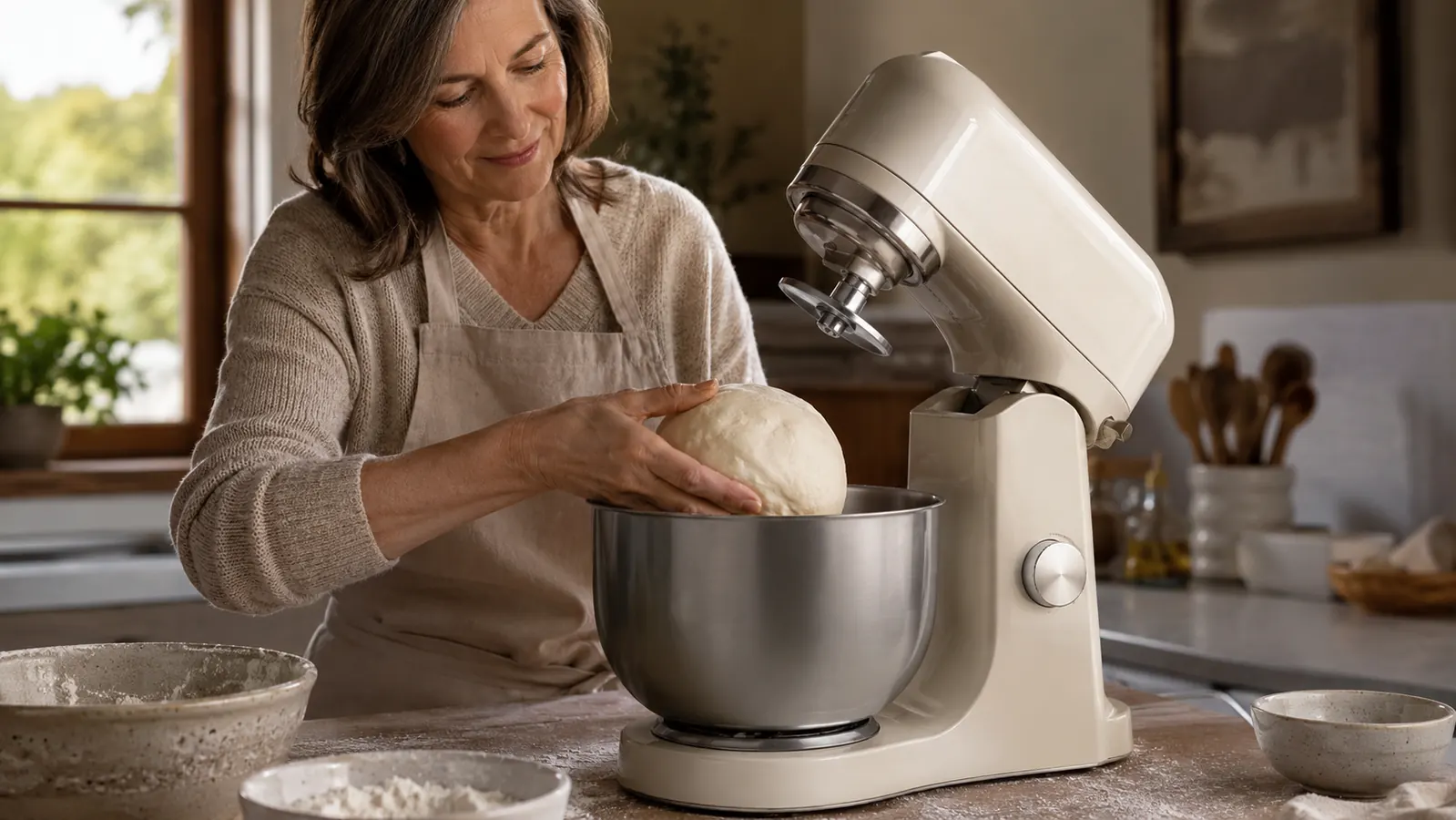
Here is the biggest honest surprise of the whole year. That 5-quart bowl fits one good loaf of bread easily. It fits two loaves like a dare, with the dough climbing halfway up the center post. And the recipes in so many books are written for a bowl that is effectively bigger than this one. Three cups of flour with a couple of eggs and some butter, and you are already worrying about the dough reaching the top of the beater.
It is not a flaw in the machine. It is a mismatch between what the words "5-quart" promise and what a home recipe actually needs. When I shop for this again, or when a friend asks me, I tell them the same thing: if your recipes routinely call for more than four cups of flour, you want to look long and hard at the larger bowl-lift model before you buy. Nobody puts this in the review as clearly as it deserves.
For my twice-weekly single loaves it has been plenty. But I want you to read your own recipes and count the flour before you choose, because this is the one place I genuinely size-checked myself and came away feeling I had been sold a shade too optimistically.
Cleaning: The Honest Truth
Let me be direct. The bowl, the beater, and the dough hook all wash by hand, because they have a bare metal finish that a dishwasher will dull and, worse, mark with the dark water stains that never really scrub off. If you bake the way I do, that is three pieces of metal in the sink almost every day. It is not hard, but it is the daily chore the ads never show you. If you were hoping to toss the whole thing in the dishwasher and walk away, this is not the model for that fantasy.
The wiring and vents on the top stay dry if you are careful, and they have never given me trouble. A dry pastry brush clears the flour out of the hinge groove after a bake. The one thing I had to learn is the tilt-head trick: you have to push the head down with a little purpose, and there is a moment where it feels like it will catch or pinch. It does not, but the first few times felt wrong enough that I stopped and checked the manual. That first little moment of pinch is the single thing the glossy photos never warn you about.
The honest bottom line on cleaning is this: if you bake once a week, you are hand washing three pieces of metal a week, and it is a two-minute job. If you bake every day, that daily honesty will either feel like a small ritual or a small irritation, depending entirely on who you are.
Weight, Noise, and the Room It Takes
Nobody warns you about the weight until you lift it. The machine sits heavy on the counter, and I mean that as a compliment, because it does not shimmy or walk even when it is pushing a stiff dough through a loaded bowl. But it is not something you will want to haul out of a cabinet every other day. Mine lives on the counter behind the mixing bowls, and that one small decision, leaving it out where I can see it, is the reason it gets worked twice a week instead of twice a month. The tools you can see are the tools you actually reach for.
The noise is honest and real, so let me be straight about it. It is not silent. On the lower settings it hums low and unobtrusive, and I have run it at six in the morning without waking the dogs, which is my real test of quiet in a house I keep. But a heavy bread dough on the higher speeds makes a working thrum you can hear clear across the room. Online reviewers treat that noise as a scandal. It is the sound of a motor doing its job, and in fourteen months it has never once bothered me the way the complaints suggested it would.
The room it takes is the last honest part. The footprint is roughly that of a medium toaster oven, and it is taller than you expect. With the head tipped up it clears my upper cabinet only because I cleared one shelf on purpose. Before you buy, measure the height under your cabinets with a tape measure, not your eye, and make sure the counter has real depth. That kind of plain practicality is the part never shown in the glowing photos, and it is the part that decides whether a machine this size lives on your counter or dies in a cabinet.
What It Will Not Do for You
An honest review has to tell you what the tool will not fix, cheaply or at all. The KitchenAid will not knead a heavy, wet bread dough without you stepping in to scrape the sides a few times. It will not grind coffee, it will not stuff a single batch of fifty cookies in one go, and it will not make your pasta without you buying more pieces that you will have to clean and store. Every one of those is an extra attachment and an extra drawer of stuff, and my rule about clutter means I have deliberately bought none of the pasta and grain mills. That is not a complaint about the machine. It is simply the true boundary of what any stand mixer does, and knowing it up front saves you a drawer of regrets.
It also will not fix what is really a bowl-size problem, which is the honest trap I described above. No amount of extra capacity in the motor helps you when the bowl itself tops out. The machine will happily spin a bowl that is too full for the dough, and the dough will happily climb over the center post, and on the day that happens you will be scraping dough out of a hinge, and you will blame yourself instead of the sizing on the box.

The Everyday Stuff Nobody Films
Let me give you the unglamorous list of what I actually run it through, because the internet mostly shows the pretty finished bake. Whipped cream goes from flat to pompous in about ninety seconds and never splashes once I got the pour shield seated correctly. Chocolate chip cookie dough, two and a half dozen worth, mixes even and hands-free while I get the pans ready. Mashed potatoes hold their heat and whip smooth without me standing there chasing lumps with a masher. These are the boring jobs, and they are the ones that actually run most weeks.
The speed dial is my one genuine fuss, so I will name it plainly. It is a solid little lever with ten stops, but the low speeds sit close together, and I spent a solid month sliding right past the setting I meant. You get the feel for it, and the online complaints about it are honestly the most overstated issue in the whole review. Once you learn that the first three numbers do the gentle work and the top letter does the fast, it stops being a problem entirely.
One more honest note about the everyday reality. When a dough is wet and heavy, the head does a tiny wobble at the top speed, and I have learned to stay near the machine when it is working a stiff loaf. It has never skipped, stalled, or walked the counter, but I do not leave the room with a heavy bread dough running, the same way I do not walk away from a frying pan of hot oil. That is a small discipline, not a defect, and it is the single thing the glossy product shots will never show you.
And the pour shield, which I was ready to swear at before I understood it. You have to seat it so the little tab on top engages, and the moment it clicks in, it works exactly as promised. Wet ingredients go in through the chute with the machine running and nothing flies anywhere. It took me two uses to learn the seat, and now I would not mix a wet batter without it. That is the pattern with most of this machine: a small learning curve, then years of quiet competence.
When my mother comes over on a Sunday, the machine is the thing she circles back to, and I get to watch her rediscover it across the same recipes she used to make by hand. There is something about the weight and the tilt that reads as sturdy rather than shiny. She was genuinely scandalized when I said the bowl goes in the sink by hand. Then she saw the bare metal finish and nodded, because her generation already knew you do not put good metal in the dishwasher. It is a small thing, but it tells you the kind of tool the KitchenAid has always been: patient, heavy, and willing to be passed down.
Fourteen months of twice-weekly bread, and the motor has never strained. The bowl, though, has a very real opinion about three loaves worth of dough. That one sentence decides who this mixer is actually for.
Where the Money Really Goes
The machine itself is the smallest part of the money in the end. The honest math I wish someone had handed me: the mixer is one price, and then every attachment you fancy is another price on top, and the brand's bowls and beaters are priced like jewelry. If you let the fun attachments talk you into it, you will have spent half again the price of the machine before a single year is out. Talk yourself into two extras and you have effectively bought the machine twice.
Here is the plain-spoken advice from someone who resisted it. Decide on the one or two things you will actually use the mixer for. Buy the machine for that. Then leave the extra attachments alone for a solid six months, until you can prove to yourself they would earn a drawer. I broke this rule's spirit on a whisk attachment I use maybe twice a year, and it is the one thing in my kitchen I regret buying.
For the price it asks, the KitchenAid is a genuine workhorse, and I would buy it again. But buy it for what you reliably bake, not for the version of yourself in the brochure who noodles pasta every weekend.
What I Liked
- Bread dough in about eight minutes, and my wrist notices the difference within a week
- Replacement bowls and beaters are easy to find years down the road
- Quiet enough to run at six in the morning without waking the house
- Handles a double batch of cookie dough without straining for a second
- The pouring shield works well once you know the trick of seating it correctly
Where It Falls Short
- The 5-quart bowl honestly behaves more like 4.5 once eggs and paste come into it
- Bowl, beater, and dough hook all need hand washing every bake
- It is heavy, and I rearranged a whole lower cabinet just to store it
- The price climbs fast the moment you start adding attachments
- Tilt-head needs a firm push and a beat of confidence on the way back down
Who This Is For
This is for the cook who bakes bread or cookies at least every couple of weeks and who is tired of sore arms and uneven whipping. It is for the person who wants one machine to last twenty years, who does not mind a three-piece hand wash in exchange, and who will actually keep it on the counter where the weight is useful. If that sounds like your kitchen, the KitchenAid will quietly become one of the most-used things you own, the way mine has.
Who Should Skip It
Skip it if you are a once-a-month baker who mostly whips cream and beats the occasional egg. For that use, a good hand mixer weighs nothing, takes up no counter, and costs a bundle less. Skip it too if your counters are short, because this is a heavy machine and mine lives in a cabinet I emptied on purpose. And if your signature recipes routinely call for five cups of flour, reach for the larger bowl-lift model instead and thank me later. An honest yes for the right cook, and an honest no for the wrong one, and there is nothing wrong with finding out which one you are before you buy.
The Honest Bottom Line
Fourteen months in, I would buy the KitchenAid again, with the size of my own recipes in mind this time. If you bake regularly, it will earn its counter and its price. If you do not, save your money and your counter space.
Amazon Check Today's Price on Amazon →